
Lightweight Composite Panels for Electric Vehicles
Make a requestGive us a call: +49 5976 9471 - 251Every kilogram saved increases the range of a battery electric vehicle (BEV)—and reduces energy consumption. Aircell polypropylene (PP) air-cell panels are manufactured using VACU-form WISCHEMANN’s patented 3D deep-drawing process and can reduce weight by up to 70% compared to solid flat panels. For OEM buyers and suppliers seeking lightweight composite panels for automotive manufacturing, Aircell panels offer verifiable material properties, 10 thickness-grammage combinations (5–16 mm), and optional special coatings—all from a single source.
Why Lightweight Construction Is Crucial for Electric Vehicles
The relationship between vehicle weight and energy consumption is more direct in BEVs than in internal combustion engines: Less weight means less battery capacity for the same range—or more range for the same capacity. For procurement professionals in the automotive components sector, this means that material choices have a direct impact on the vehicle’s range specifications.
At the same time, regulatory requirements regarding recyclability and material transparency are increasing—as exemplified by the EU Battery Passport and the End-of-Life Vehicles (ELV) Directive. Monolithic materials such as GRP are coming under pressure as a result. Thermoplastic lightweight panels made of PP—such as the Aircell variants—can be sorted by type and fully integrated into the plastics recycling cycle.
Further Reading: Background Information on Weight Reduction and the Carbon Footprint in Lightweight Construction.
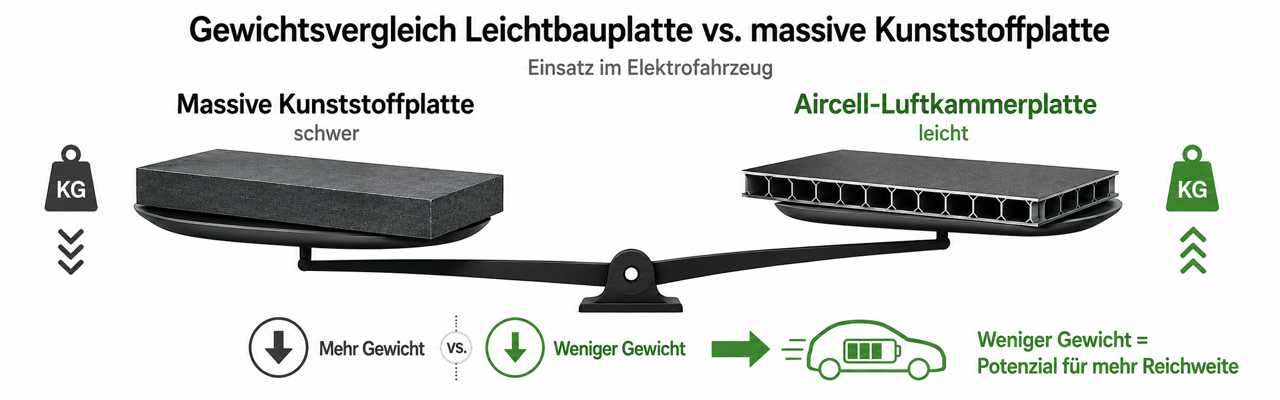
Aircell Panels: Save Weight, Gain Range
The patented 3D deep-drawing process creates a closed-cell air chamber structure that combines planar stability with minimal material usage. Compared to extruded multi-wall sheets (hollow-core sheets), Aircell sheets have a uniformly flat surface on both sides—a decisive advantage for bonding processes, coatings, and assembly precision in automotive manufacturing.
The following table shows the thickness-grammage combinations available in the live configurator, as well as typical applications in electric vehicles:
Strength |
Weight per unit area |
Application |
| 5 mm | 1,500 g/m² | Flexible partition elements, door modules |
| 9 mm | 2,300 g/m² | Standard body components |
| 10 mm | 3,000 g/m² | Medium-duty, loading platforms |
| 11 mm | 4,000 g/m² | Reinforced structural components |
| 15 mm | 5,000 g/m² | High strength, trunk liners |
| 16 mm | 6,000 g/m² | Maximum strength |
Source: Aircell Panel Configurator (aircell-platten.com/platten/platten-konfigurator/)
In addition, special coatings such as TPE (anti-slip), ESD (conductive), and non-woven lamination are available—relevant for interior vehicle components, load sill protection, and high-voltage environments. The sheet configurator is available for custom requirements.
Applications in Electric Vehicles
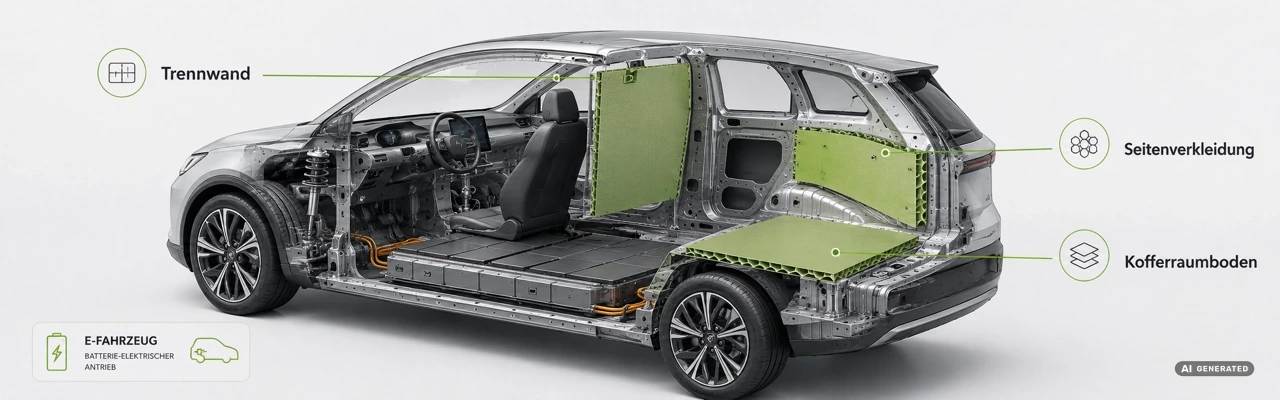
Aircell panels can be used in various locations within an electric vehicle where the balance between weight, stiffness, and surface quality is critical:
-
- •Trunk floor and cargo floor: Thicknesses ranging from 10 to 16 mm with weights per unit area of 3,000 to 6,000 g/m² provide the necessary compressive strength to handle varying load weights while keeping the material’s own weight to a minimum.
- •Door panels and side panels: 5-mm-thick Aircell panels can be used as a shaping substrate for foam or textile coverings. The smooth surface allows for direct bonding without pretreatment.
- •Cargo compartment partitions and false floors: In the commercial vehicle and light-duty van segment, 9–15 mm-thick Aircell panels can serve as a lightweight alternative to plywood partitions. Details can also be found in the section on Aircell panels in the transportation industry.
Material Properties for E-Mobility
In addition to weight, other material properties are important for use in electric vehicles. Aircell panels are made from PP thermoplastics:
PP (polypropylene): The lightest material available in the Aircell product line; food-safe, moisture-resistant, and fully recyclable. Ideal for indoor applications without high mechanical load requirements.
The sheets can be manufactured in RAL colors and, upon request, coated with TPE or ESD. Further details on thickness and basis weight are provided in the Panel Configurator. The page provides background information on 3D honeycomb structure technology Aircell Panels with 3D Honeycomb Structure.
Sustainability and Recyclability
For OEM buyers who are subject to CSRD reporting requirements or internal ESG targets, the following product characteristics of Aircell panels are relevant:
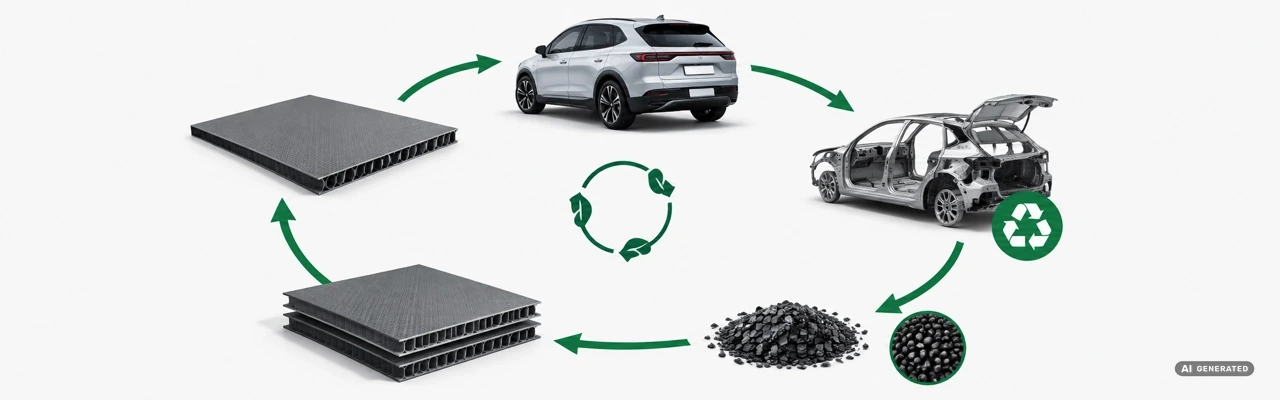
- •Single-material structure: Aircell panels are made of a single thermoplastic (PP) without any adhesive bonds or foreign inserts. This enables single-material sorting at the end of life in accordance with the requirements of the ELV Directive.
- •100% recyclable: The patented thermoforming structure does not alter the chemical composition of the raw material—the sheets can be fully incorporated into new products as PP recyclate.
- •Resource-efficient manufacturing: Compared to solid sheets, the 3D thermoforming process requires significantly less raw material while providing the same surface area and similar stiffness. Production takes place at the Salzbergen (Germany) facility of VACU-form WISCHEMANN GmbH & Co. KG.
The article “Sustainability Through CO₂ Reduction in Lightweight Construction” provides a more comprehensive look at the impact of lightweight construction measures on CO₂ emissions.
Partnerships with E-Mobility Manufacturers
VACU-form WISCHEMANN supplies Aircell sheets as configurable semi-finished products—not standard stock items from the warehouse, but custom-cut sheets tailored to customer specifications. This is particularly relevant for development departments that wish to source both prototype and production materials from a single supplier.
The following points are typical of collaborations with e-mobility manufacturers:
- •Initial Sample Inspection: Upon request, VACU-form WISCHEMANN provides sample sheets in the desired thickness-grammage combination, including material certificates for quality assurance.
- •Batch sizes suitable for series production: Aircell panels can be manufactured in both small batches (e.g., vehicle production runs) and large-scale production runs. The specific minimum order quantity depends on the material and format—please submit inquiries via the configurator or directly by phone.
- •Technical Consulting: The Applications Team provides support with material selection, FEA-compliant design, and component qualification. Please contact us using the contact form.
Frequently asked questions
How much weight can I save by using Aircell panels compared to solid plastic panels?
Aircell sheets can save up to 70% in weight compared to solid sheets made from the same thermoplastic. The exact value depends on the selected combination of thickness and grammage. Example: A 9-mm Aircell sheet made of PP weighs 2,300 g/m²—a solid PP sheet of the same thickness can weigh several times as much.
Which materials are best suited for electric vehicles?
For indoor applications without increased mechanical stress, we recommend PP (the lightest material, food-safe, fully recyclable).
Are Aircell panels suitable for high-voltage applications in electric vehicles?
Aircell sheets are not an approved insulation material for high-voltage cables or HV components. The optional ESD coating may be relevant for ESD-sensitive areas in the manufacturing or packaging of HV components. For specific requirements, we recommend consulting directly with our applications team.
How can Aircell panels be recycled at the end of a vehicle's service life?
Aircell panels are made of a single thermoplastic and can be sorted by material type at the end of the vehicle’s life and recycled. The monomaterial structure makes it easier to comply with the requirements of the EU End-of-Life Vehicles (ELV) Directive.
What is the process for submitting a request for e-mobility projects?
The fastest way is to use the online configurator at aircell-platten.com/platten/platten-konfigurator/—there, you can enter dimensions, thickness, material, and special coatings, and the information is sent directly to the sales team. Quotes are typically provided within 24 hours. Alternatively, you can make an inquiry by phone at +49 5976 9471-251.