
Aircell: The future of lightweight construction
Innovations for sustainable construction with 3D honeycomb structure Make a requestGive us a call: +49 5976 9471 - 251Reduce weight, increase stability
Aircell panels with 3D honeycomb structure: the revolution in sustainable lightweight construction
Modern industry is facing enormous challenges: Resource scarcity, rising transportation costs and growing environmental demands require innovative solutions. In response to these challenges, we at Aircell Platten have developed a revolutionary technology that sets new standards in sustainable lightweight construction thanks to its unique 3D honeycomb structure. Our panels combine apparent opposites – maximum stability with minimum weight, industrial performance with maximum environmental protection. With up to 70% weight reduction compared to conventional materials, our products not only significantly reduce CO₂ emissions and transportation costs, but also open up completely new possibilities in product design. The complete recyclability and resource-saving production make Aircell sheets a key element for companies that want to reconcile profitability and sustainability. In this comprehensive overview, you will learn how our 3D honeycomb technology is transforming industries such as logistics, construction, automotive and exhibition stand construction and why more and more leading companies are turning to this innovative solution.
| Feature | Advantage |
|---|---|
| 3D honeycomb structure technology | Offers exceptional stability with minimal use of material |
| Up to 70% weight reduction | Significantly reduces transportation and handling costs |
| Fully recyclable polypropylene | Enables closed material cycles and reduces CO₂ emissions |
| Versatile applicability | Solutions for logistics, construction, automotive and more |
| Shock and moisture resistant | Ensures reliable product protection under a wide range of conditions |
Table of contents
1. The 3D honeycomb structure: the basis for sustainable innovation
2. Material science and technical properties
3. Sustainability aspects of Aircell panels
4. Cross-industry application areas
5. Comparison with conventional lightweight construction solutions
6. Product variants and customization options
7. Future prospects and innovation potential
8. Practical examples and success stories
9. Glossary: Understanding technical terms in lightweight construction
10. Frequently asked questions about Aircell panels
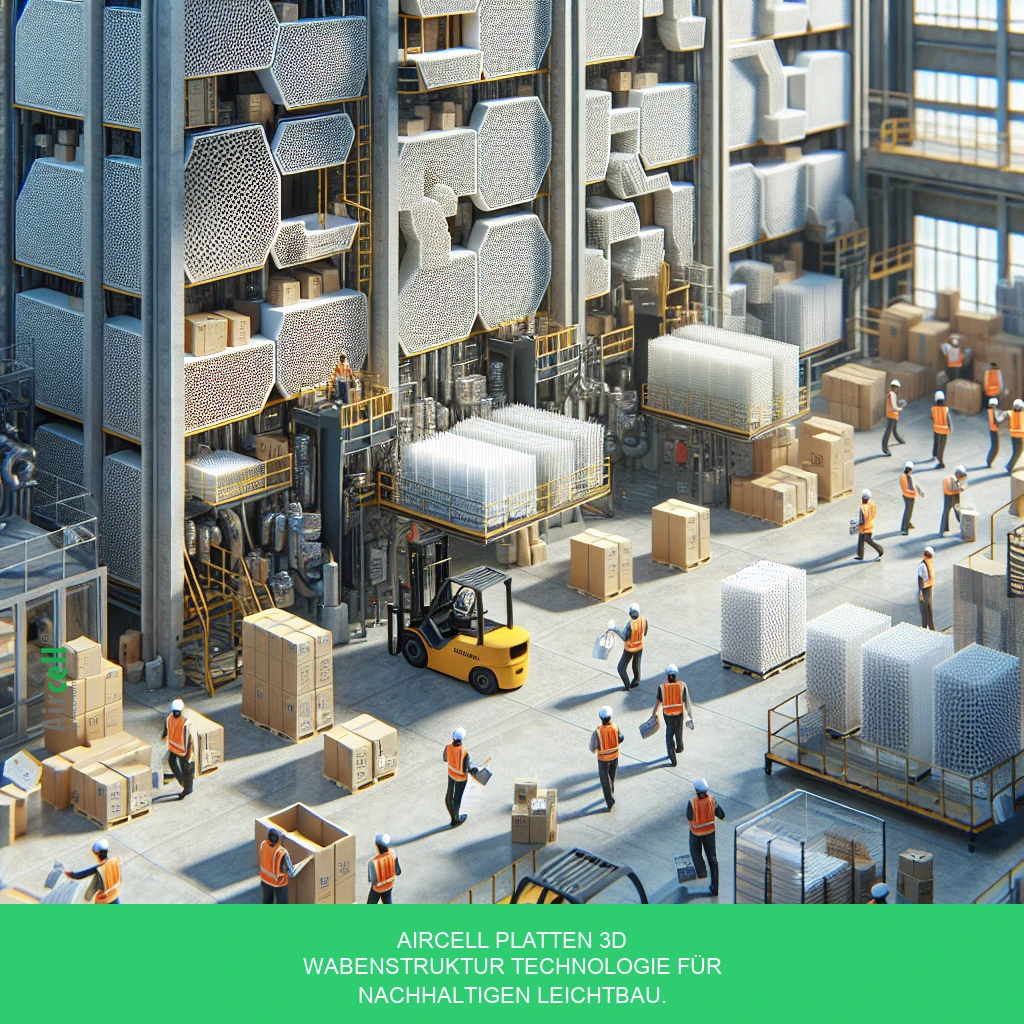
The 3D honeycomb structure: the basis for sustainable innovation
The 3D honeycomb structure is at the heart of our revolutionary technology. Unlike conventional two-dimensional honeycomb structures, which mainly provide stability in one plane, our three-dimensional structure works equally effectively in all spatial directions. This principle, borrowed from nature, combines maximum stability with minimum use of materials.
Biomimetic design principles
The development of our 3D honeycomb structure is based on biomimetic principles – the targeted imitation of natural structures. Over millions of years of evolution, nature has developed perfect lightweight construction solutions, such as those found in honeycombs or bone cancellous bone. Our engineers have analyzed these principles and transferred them into an industrially usable form. The result is a honeycomb structure with cross-linked cavities that optimally distributes forces and thus achieves exceptional stability with minimal material consumption.
The cellular connection technology of our panels enables an even distribution of force in all directions. This is in contrast to conventional sandwich constructions, which often have weak points at the connection points. Thanks to the isotropic load-bearing capacity, our products remain dimensionally stable and resistant even under complex load scenarios.
Production process and technical implementation
The manufacturing process for our Aircell panels is based on a patented inline thermoforming process. In contrast to traditional composite materials, which often require complex gluing processes, our panels are manufactured in a continuous process. This not only reduces energy consumption during production, but also avoids the use of environmentally harmful adhesives.
The starting point is high-quality polypropylene (PP) or high-density polyethylene (HDPE), which is first processed into films. These films undergo a precise thermoforming process that creates the characteristic 3D honeycomb structure. The top and bottom cover layers are then firmly bonded to the honeycomb fabric using a thermal process, creating a monolithic structure without adhesives.
“Aircell’s 3D honeycomb structure represents a paradigm shift in industrial lightweight construction. Thanks to the intelligent material arrangement, we achieve stability values that would only be possible with conventional technologies by using significantly more material.”
Focus on mechanical properties
The special mechanical properties of our 3D honeycomb structure result from the optimized geometry of the cells. Compared to conventional corrugated cardboard structures or foamed materials, Aircell panels offer:
– Significantly higher flexural rigidity thanks to the controlled design of the cell structure
– Better compressive strength thanks to the three-dimensional force distribution
– Higher energy absorption under impact loads
– Excellent dimensional stability even under changing climatic conditions
– Consistent quality over the entire service life
These properties make our sheets the ideal solution for demanding applications where weight reduction and mechanical strength are equally important. The homogeneous structure also ensures uniform quality across the entire panel surface – a decisive advantage over materials with an irregular internal structure such as foams.
Material science and technical properties
The choice of material plays a decisive role in the performance and sustainability of lightweight components. With Aircell sheets, we rely on high-quality thermoplastic polymers that have both outstanding technical properties and an optimum environmental profile.
Polypropylene: The ideal material for 3D honeycomb structures
Polypropylene (PP) has proven to be the ideal base material for our 3D honeycomb structure. This semi-crystalline polymer combines several decisive advantages:
– Excellent strength-to-weight ratio
– High chemical resistance to acids, alkalis and organic solvents
– Insensitive to moisture and hydrolysis
– Low creep tendency under long-term stress
– 100% recyclable in the material cycle
– Food-safe for packaging applications
The material’s good processability also enables precise and energy-efficient production processes. By using special additives, we can modify the properties in a targeted manner, for example to increase UV resistance or improve fire protection properties.
Mechanical characteristics and load limits
The mechanical properties of our Aircell panels have been characterized in extensive tests in accordance with international standards. Depending on the application requirements, we offer various material thicknesses and cell sizes that cover different load profiles. Typical characteristic values for our standard panels with a thickness of 5 mm are
– Basis weight: 1000 g/m² to 5000 g/m²
– Flexural strength: > 2.5 Nmm²/mm
– Compressive strength: > 0.8 MPa at 10% compression
– Tensile strength: > 15 MPa in longitudinal and transverse direction
– Temperature resistance: -20°C to +80°C in continuous use
These values illustrate the exceptional performance of the material while at the same time drastically reducing its weight. The uniform load-bearing capacity in all directions (isotropy) represents a decisive advantage over directional structures such as corrugated cardboard or twin-wall sheets.
Physical properties for a wide range of applications
In addition to their mechanical properties, our Aircell panels are characterized by a range of physical properties that enable them to be used in a wide variety of applications:
– Moisture behavior: In contrast to cellulose-based materials, PP-based Aircell sheets absorb virtually no moisture. This guarantees dimensional stability and consistent mechanical properties even under humid conditions.
– Chemical resistance: The polymers used are resistant to most chemicals, including acids, alkalis, oils and cleaning agents. This makes them ideal for applications in chemically demanding environments.
This combination of advantageous mechanical and physical properties makes our innovative packaging solutions a versatile alternative for a wide range of industrial requirements.
Sustainability aspects of Aircell panels
Sustainability is not an additional feature, but a basic principle in the development and production of our Aircell panels. Through the intelligent combination of material efficiency, energy-optimized production and closed material cycles, we achieve an ecological profile that clearly outperforms conventional materials.
Resource efficiency through intelligent material reduction
The 3D honeycomb structure of our panels follows the basic principle of “less is more”. By specifically arranging the material where it is needed for structural strength, we reduce the use of raw materials by up to 70% compared to solid materials. This material efficiency has a positive effect on several levels:
– Reduced raw material consumption: significantly less polypropylene is required for the same surface area
– Reduced energy consumption during production: less material means less energy required during production
– Minimized transport emissions: The lower weight significantly reduces CO₂ emissions during transportation
Circular economy and complete recyclability
Our Aircell sheets are designed as a mono-material solution – they are made exclusively from polypropylene without any additional adhesives or composite materials. This enables simple and complete recyclability at the end of the product life cycle:
1. pure collection: the sheets can easily be collected in the existing plastics recycling system
2. Mechanical recycling: Shredding and processing produces high-quality secondary PP
3. Direct recycling: The recycled material can be used directly in new products
In cooperation with our customers, we have already established closed material loops in which used Aircell panels are taken back, recycled and processed into new products. This closed-loop recycling not only reduces the need for new material, but also minimizes the environmental impact over the entire life cycle.
“Our decision to use Aircell sheets has reduced our carbon footprint in the packaging sector by more than 40%. The combination of weight savings and closed-loop recycling was crucial to this significant improvement in our environmental footprint.”
CO₂ reduction through weight optimization
An often underestimated aspect of sustainability lies in the indirect emission savings during the use phase. Due to the low weight of our panels, considerable CO₂ savings are achieved, particularly in the transportation sector:
– Reduced fuel consumption: Lighter containers and packaging mean less fuel consumption per transported unit of goods
– Increased payload: More goods can be transported per trip with weight restrictions
– Lower energy consumption during handling: Less energy is required in automated storage systems and during manual handling
A recent study with one of our logistics customers showed that switching to Aircell container rings reduced transport-related CO₂ emissions by 28%, while at the same time increasing the volume of goods transported by 15%.
Sustainable production processes
Not only the product itself, but also our production processes are geared towards maximum sustainability:
– Energy-efficient production: Our patented inline process requires significantly less energy than comparable processes
– Closed water circuits: Cooling water is fed into a closed system and reused
– Waste avoidance: Production waste is fed directly back into the manufacturing process
– Renewable energy: Our production sites are increasingly powered by electricity from renewable sources
These measures have enabled us to reduce production-related CO₂ emissions by more than 35% in the last five years – a further contribution to our vision of climate-neutral production by 2030.
Cross-industry application areas
The versatile properties of our Aircell panels with 3D honeycomb structure open up application possibilities in numerous industries. From logistics and construction to the automotive industry – wherever a combination of lightness, stability and sustainability is required, our products offer optimum solutions.
Logistics and transportation industry: Weight-reduced container systems
In the logistics sector, the focus is on increasing the efficiency of transportation processes. Our Aircell panels are revolutionizing this area by:
– Lightweight container systems: With our container rings, standard pallets can be easily converted into lightweight and stable transport containers. The reduced weight saves fuel and increases the payload.
– Customized inner packaging: Easy to process, custom-fit inner packaging can be produced for sensitive goods, providing maximum protection with minimum weight.
– Stackable load carriers: The high compressive strength enables the development of stackable container systems that retain their shape even when transported in multiple layers and reliably protect the goods.
– Pallet collars and layer pads: As a lightweight alternative to wood or solid plastic, our sheets can be used as pallet collars or layer pads to secure loads.
The container ring configurator enables our customers to design individual solutions for their specific transport requirements. The modular design allows flexible adaptation to different loads and transport conditions.
Construction industry: lightweight construction elements and wall systems
In the construction industry, our Aircell panels open up new perspectives for sustainable and efficient building:
– Lightweight partition wall systems: As a core material in composite panels, our boards enable the construction of lightweight but stable partition walls for interior fittings.
– formwork elements: The moisture resistance and high dimensional stability make Aircell panels a reusable alternative for concrete formwork.
– Insulation core material: The trapped air in the 3D honeycomb structure offers good thermal insulation properties which, in combination with other materials, lead to highly efficient insulation systems.
– Sustainable building wall systemsAs a basic element for modular construction methods, our panels contribute to a resource-saving and fast construction method.
The development of revolutionary lightweight construction solutions for the construction industry is a key focus of our research activities. In cooperation with leading architecture and engineering firms, we work on pioneering concepts for energy-efficient and sustainable building structures.
Automotive industry: lightweight construction for greater efficiency
The automotive industry is under enormous pressure to reduce vehicle weight and improve sustainability at the same time. Our Aircell panels for the automotive industry offer a wide range of solutions:
– Interior linings: As a carrier material for door panels, headliners or trunk linings, they combine low weight with good acoustic properties.
– Structural elements: In combination with fiber reinforcement, our sheets become high-strength structural components for non-load-bearing components.
– Transport packaging: For the safe transportation of sensitive vehicle components, our tailor-made packaging solutions offer optimum protection with minimum weight.
– Battery housings for e-mobility: The electrical insulation properties and good processability make our sheets an interesting material for lightweight battery housing components.
By working closely with leading car manufacturers, we are continuously developing new applications that contribute to weight reduction and thus to increasing efficiency in the vehicle industry.
Exhibition stand construction and event structures
Exhibition stand construction benefits in particular from the combination of lightness, stability and ease of processing of our panels:
– Modular exhibition stand systemsThe lightweight but sturdy panels enable exhibition stands to be set up and dismantled quickly with simplified transportation.
– Decorative elements: Good printability and coating options create attractive visual elements with minimal structural mass.
– Event structuresTemporary structures for events benefit from quick assembly and low transportation weight.
– Presentation surfaces: As a base material for displays and information boards, our panels provide a stable but lightweight basis.
The sustainability of our material solution is an increasingly important factor, especially in trade fair construction, as the topic of green events is becoming more and more important. The complete recyclability and low transport weight contribute significantly to improving the ecological balance of trade fair presentations.
Furniture industry and interior design
In furniture production, our panels open up new design and construction possibilities:
– Lightweight furniture: As a core material for cupboard doors, table tops or shelves, they enable a considerable reduction in weight while retaining the same stability.
– Room dividers and partition walls: The good sound absorption in combination with the low weight predestines our panels for modern room concepts in office and residential environments.
– Display and shopfitting elements: In shopfitting, our panels are used for easily changeable presentation systems.
– Furniture for temporary use: Lightweight and easy to assemble are key features of event furniture or temporary furnishings.
The combination of functional properties and design possibilities makes our Aircell panels a versatile material for innovative furniture concepts and creative interior design solutions.
Comparison with conventional lightweight solutions
In direct comparison with other lightweight construction materials, Aircell panels with a 3D honeycomb structure show clear advantages in terms of performance, sustainability and cost-effectiveness. An objective consideration of the various options helps to select the optimum material for specific applications.
Aircell panels vs. corrugated cardboard and cardboard packaging
Corrugated board is a frequently used lightweight material, especially in the packaging sector. However, a comparison reveals decisive differences:
– Moisture resistance: While corrugated board loses its structural integrity when exposed to moisture, Aircell sheets retain their full stability even in damp conditions.
– Long-term stability: Cardboard tends to creep under load and loses strength over time. Aircell sheets retain their mechanical properties permanently.
– Reusability: Unlike corrugated cardboard, which is usually only designed for one use, Aircell sheets can be reused many times, which further improves the overall eco-balance.
– Load-bearing capacity: The 3D honeycomb structure offers significantly higher compressive strength and flexural rigidity than comparable corrugated board structures of the same weight.
Our boards offer decisive advantages over cellulose-based materials, particularly in applications with higher requirements for stability, moisture resistance and durability.
Aircell panels vs. foams
Foamed materials such as EPS (polystyrene), EPP or PUR foams are widely used lightweight construction solutions. A comparison with Aircell panels shows the following differences:
– Recyclability: While many foams are difficult or impossible to recycle, our mono-material PP sheets enable 100% closed-loop recycling.
– Uniform structure: In contrast to foams with their random cell structure, Aircell panels offer a precisely defined geometry with predictable mechanical properties.
– Processing options: Aircell panels can be cut, drilled and routed with standard woodworking tools, whereas foams often require special processing techniques.
– Surface quality: The smooth, closed surface of our sheets allows easy further processing by printing, coating or laminating, which is often problematic with foams.
Especially in applications where defined mechanical properties, good processability and complete recyclability are required, Aircell sheets offer clear advantages over foamed materials.
| Feature | Aircell panels | Corrugated cardboard | EPS foam | Honeycomb panels (paper) |
|---|---|---|---|---|
| Weight | Low | Low | Very low | Low |
| Moisture resistance | Very good | Poor | Moderate | Poor |
| Recyclability | 100% (unmixed) | Good (if uncoated) | Limited | Good (if uncoated) |
| Reusability | Very good | Limited | Limited | Limited |
| Compressive strength | High | Moderate | Moderate | Moderate |
| Workability | Good | Simple | Complex | Simple |
Aircell panels vs. honeycomb sandwich structures
Traditional honeycomb sandwich structures (e.g. with honeycomb cores made of aluminum or paper) are also frequently used in lightweight construction:
– Isotropic properties: In contrast to conventional honeycomb cores, which are mainly load-bearing in the direction of thickness, the 3D honeycomb structure of our panels offers uniform strength in all directions.
– Production effort: Honeycomb sandwiches typically require complex bonding processes between the core and surface layers. Aircell panels are manufactured in an integrated process without additional adhesives.
– Edge finish: With conventional honeycomb sandwiches, edge closure is a challenge and often requires additional components. Aircell panels offer naturally closed edges.
– Cost efficiency: The industrial inline production of our panels enables more cost-effective production compared to multi-step sandwich processes.
Aircell panels offer significant advantages over classic honeycomb sandwich constructions, particularly in applications where a cost-effective but high-performance lightweight solution with low production costs is required.
Product variants and customization options
In order to meet the diverse requirements of different industries, we offer our Aircell panels in numerous variants and with extensive customization options. This flexibility enables customized solutions for almost any application in the field of sustainable lightweight construction.
Standard formats and customized dimensions
Our portfolio includes a range of standard formats that are optimized for common applications:
– Sheet sizes: From handy 600 x 800 mm to large-format 2500 x 1250 mm
– Material thicknesses: From 5 mm for lightweight packaging solutions up to 25 mm for structural applications
– Cell densities: Various cell sizes for different strength and weight requirements
In addition to these standard formats, we also manufacture customer-specific dimensions according to individual specifications. Thanks to our flexible production process, we can also produce small batches economically and thus respond optimally to specific project requirements.
Surface variants and coating options
Depending on the area of application, we offer different surface variants and coating options:
– Standard surface: Smooth, closed PP surface for most applications
– Anti-slip coating: For load securing and slip-sensitive applications
– UV-stabilized version: For outdoor applications exposed to direct sunlight
– Conductive coating: For dissipating static electricity in electronic components
– Printability: Pretreated surfaces for direct digital printing or screen printing
– Lamination: Can be laminated with decorative films, textiles or other materials
These surface variants considerably extend the range of applications for our panels and allow them to be adapted to specific functional and aesthetic requirements.
Connection and assembly technology
A decisive advantage of our Aircell panels is their ease of processing and the wide range of connection options:
– Mechanical connections: Standard screws, rivets or staples can be used without any problems
– Bonding: Good bondability with a wide variety of adhesive systems
– Welding: Thermal welding for unmixed connections
– Plug-in systems: Specially developed connecting elements for tool-free assembly
– Folding techniques: Folding structures can be realized by creasing processes
For more complex applications, we offer pre-assembled parts that are already equipped with appropriate connecting elements, hinges or other functional components. This reduces assembly work for the customer and ensures optimum functionality.
“The flexibility in adapting the Aircell panels to our specific requirements has convinced us. From the material thickness to the surface finish and customized connection solutions – we always get exactly the product we need for our demanding applications.”
Functionally integrated special variants
In addition to the standard variants, we are continuously developing new, functionally integrated special variants:
– Aircell Thermo: With additional insulation layers for improved thermal insulation
– Aircell Hybrid: Combination with other materials such as fiber composites for special requirements
These special variants are often developed in close cooperation with our customers in order to achieve the optimum combination of lightweight construction, functionality and sustainability for specific applications.
Future prospects and innovation potential
The development of Aircell panels with a 3D honeycomb structure is not a completed process, but a continuous innovation path. Our research and development department is constantly working on new material combinations, improved properties and extended application options in order to fully exploit the potential of this sustainable lightweight construction technology.
Contribution to the circular economy
As a company, we see it as our responsibility to actively contribute to the development of a functioning circular economy:
– Design for recycling: The focus of the design for all new developments is on complete recyclability.
– Recycling network: We are building our own network for taking back and recycling our products.
– Upcycling concepts: Together with partners, we develop innovative concepts to produce new, high-quality products from used Aircell panels.
– Digital material passports: We are implementing digital material passports for our products to improve traceability and more efficient cycle management.
These initiatives underline our commitment to a sustainable future and the consistent further development of our products in terms of a resource-conserving circular economy.
New fields of application
The innovative potential of Aircell panels is constantly opening up new fields of application:
– Renewable energies: Lightweight support structures for photovoltaic modules or components for wind turbines.
– Urban mobility: lightweight components for e-bikes, cargo bikes and small electric vehicles.
– DIY projects and creative applicationsDeveloping the end consumer market with user-friendly products for creative applications.
Continuous research into new fields of application is part of our innovation strategy and contributes to making the technology of 3D honeycomb structures usable in more and more areas of everyday life.
Practical examples and success stories
The practical application of our Aircell panels has led to remarkable successes in various industries. These case studies illustrate the potential of 3D honeycomb technology for sustainable lightweight solutions in real-life application scenarios.
Case study: logistics company reduces CO₂ footprint
A leading European logistics company was faced with the challenge of improving its environmental footprint and increasing transport efficiency at the same time. Impressive results were achieved with the implementation of our Aircell container rings:
– 28% reduction in the weight of the transport containers compared to the previously used wooden and plastic systems
– 15% more payload per transport due to the reduced tare weight of the containers
– 32% fewer CO₂ emissions in the overall process due to more efficient transport and recyclable materials
– 40% lower damage rate for transported goods due to improved shock absorption properties
The modular design also allows the container height to be flexibly adapted to different loads, which further increases process efficiency. The payback period for the investment was just 11 months.
Case study: Exhibition stand construction revolution with lightweight panels
An international stand builder was looking for ways to shorten set-up and dismantling times, reduce transportation costs and improve its environmental footprint. The use of our Aircell panels in exhibition stand construction led to a fundamental transformation of the business model:
– 65% lighter stand constructions compared to conventional systems
– 50% faster assembly and dismantling thanks to the easy handling of the lightweight elements
– 42% reduction in transportation costs due to lower volume and weight
– Significant reduction in back pain and injuries among assembly personnel
The contribution to sustainability is particularly noteworthy: a life cycle assessment revealed a 45% reduction in the CO₂ footprint over the entire life cycle of the exhibition stand components. The ability to fully recycle the panels after use further improves the environmental footprint.
“The switch to Aircell panels for our exhibition stands was a game changer. It wasn’t just the logistical benefits of the reduced weight that convinced us, but also the flexibility in design and the significantly improved eco-balance. Our customers appreciate the sustainable approach and we benefit from more efficient processes at all levels.”
Case study: Automotive supplier optimizes packaging process
A global automotive supplier was looking for a sustainable solution for the transportation of sensitive electronic components. The switch to customized packaging solutions made of Aircell panels brought the following benefits:
– Customized inner packaging with precise cut-outs for optimal product protection
– Reusable packaging systems with up to 30 cycles compared to disposable packaging
– Reduction of packaging costs by 27% over the entire life cycle
– Improved product protection with 95% less transport-related damage
The moisture-resistant properties of Aircell panels also allow them to be used worldwide without climate-related restrictions – a decisive advantage for global supply chains.
Case study: Sustainable construction project with lightweight walls
An innovative residential building project relied on the integration of Aircell panels in construction for non-load-bearing interior walls and achieved remarkable results:
– 75% lighter wall elements compared to conventional systems with the same acoustic properties
– Significantly faster assembly thanks to prefabricated, easy-to-handle elements
– Resource-saving construction method with reduced material quantities and complete recyclability
The project received several awards for sustainable construction and demonstrates the potential of Aircell panels for the construction industry of the future. The combination of lightness, good insulating properties and easy installation makes them a promising alternative for modern construction projects.
Case study: DIY applications in the creative sector
The ease of processing and the versatile properties have also made our Aircell panels a popular material in the DIY sector. One example is the development of a kit for modular furniture:
– Easy processing with standard tools without special equipment
– High stability with minimal weight for easily movable furniture
– Versatile design options thanks to good printability and paintability
– Durability thanks to moisture-resistant and maintenance-free properties
The positive response from the DIY community has led to a whole range of creative applications, from model making and garden projects to individual furnishing solutions. This versatility underlines the wide range of applications for Aircell panels beyond industrial applications.
Glossary: Understanding technical terms in lightweight construction
For a better understanding of the technology and its applications, we have compiled a glossary that explains the most important technical terms in the context of 3D honeycomb structures and sustainable lightweight construction.
3D honeycomb structure
A three-dimensional cell structure in which cylindrical cavities are interconnected in all spatial directions to achieve maximum stability with minimum weight.
Biomimetics
The science that analyzes structures and processes from nature and adapts them for technical applications. The 3D honeycomb structure is an example of biomimetic construction.
Carbon footprint
The total amount of greenhouse gas emissions caused directly and indirectly by a product, process or person. With Aircell panels, this is minimized through material reduction and sustainable production.
Circular economy
An economic model that aims to reuse and recycle resources in order to minimize waste and preserve the value of products and materials for as long as possible.
Weight-stability ratio
A characteristic value that describes the relationship between the weight of a material and its mechanical stability. Aircell panels are characterized by a particularly favourable ratio.
Isotropy
The property of a material to have the same physical properties in all directions. The 3D honeycomb structure of Aircell panels enables almost isotropic behavior.
Lightweight construction
A design philosophy that aims to minimize the weight of components without compromising their functionality or stability. Often realized through intelligent material arrangement or innovative materials.
Life Cycle Assessment (LCA)
A method for systematically analyzing the environmental impact of products throughout their entire life cycle, from raw material extraction through production and use to disposal or recycling.
Monomaterial
A product that consists of only one type of material, which significantly improves recyclability. Aircell sheets are an example of a monomaterial product made of polypropylene.
Polypropylene (PP)
A thermoplastic with good mechanical properties, chemical resistance and complete recyclability