
PP Hollow-Core Sheet Cutting: Service & Quality | Aircell
Make a requestGive us a call: +49 5976 9471 - 251Industrial manufacturing does not tolerate dimensional deviations. Anyone who uses PP hollow-core sheets as separators, packaging inserts, or protective sheets in mass production needs a cutting service that adheres to drawing specifications and delivers batches without the need for rework. Aircell sheets produced using VACU-form WISCHEMANN’s patented 3D thermoforming process are designed precisely for this purpose: The three-dimensional air-cell structure provides high dimensional stability, making the cutting process more precise and reproducible than with conventional hollow-core sheets.
This page explains dimensional tolerances, available thicknesses, coating options, and pricing parameters—so you can make an informed inquiry.
Precise cutting to your specifications
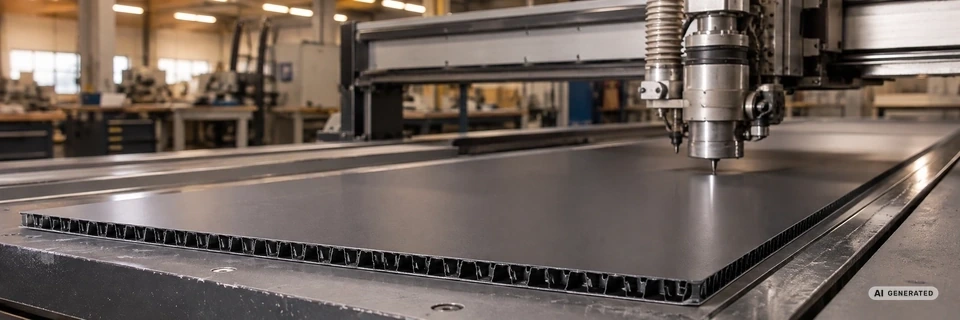
Aircell sheets made of polypropylene (PP) can be custom-cut to exact dimensions using all standard processing methods: sawing, punching, milling, and thermoforming can all be performed reliably. The 3D deep-drawn structure remains closed at the cut edge—an advantage over extruded hollow-core sheets, where open channel edges absorb moisture and pose problems in cleanroom or food-processing environments.
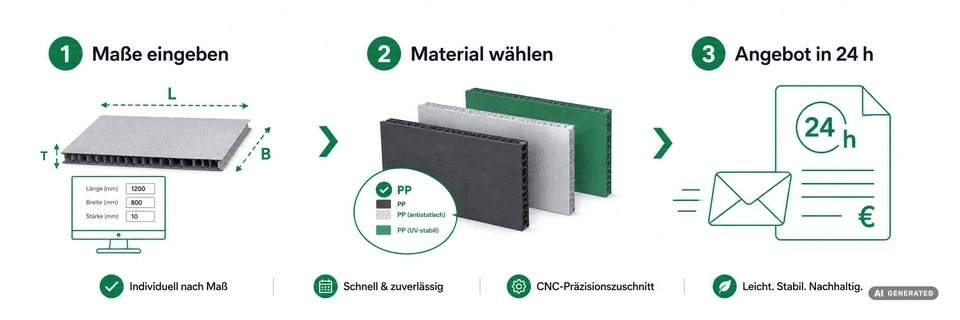
Using the Aircell Sheet Configurator, you can enter the length, width, and quantity directly. Our sales team will typically confirm feasibility and tolerances within 24 hours.
-
- •Customdimensions: Length x Width in mm, without grid constraints
- •Cut edgesare smooth as dust; no burrs in a standard cut
- •Tolerancesvary by project; production requirements available upon request
- •Technicaldrawings (PDF, SVG, AI) can be uploaded in the configurator
- •Custom finishes(cutouts, drill holes) available upon request
Material Quality and Properties
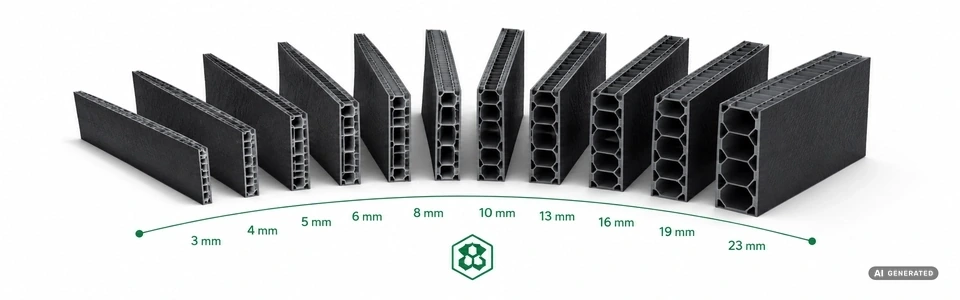
Das Basismaterial ist Polypropylen (PP) – ein lebensmittelkontakttaugliches, lösungsmittelbeständiges Thermoplast mit gutem chemischem Widerstand und 100 % Recyclingfähigkeit am Lebensende. Die Aircell-Tiefziehstruktur verdoppelt die Schichtung zum dreidimensionalen Luftkammerkörper: Das Ergebnis ist eine Platte, die bei bis zu 70 % Gewichtsreduktion gegenüber Vollmaterial vergleichbare Flachdruckwerte erreichen kann.
Folgende Tabelle zeigt die verifizierten PP-Konfigurator-Optionen:
Stärke |
Grammatur |
Typische Einsatzklasse |
Beschichtung möglich |
| 5 mm | 1.500 g/m² | Flexible Inlays, Verpackungseinlagen | TPE, ESD, Vlies |
| 9 mm | 2.300 g/m² | Standard-Transportschutz | TPE, ESD, Vlies |
| 9,5 mm | 2.500 g/m² | Standard-Transportschutz | TPE, ESD, Vlies |
| 10 mm | 3.000 g/m² | Mittlere Belastung, Trennwände GLT | TPE, ESD, Vlies |
| 11 mm | 4.000 g/m² | Verstärkte Ausführung Automotive | TPE, ESD, Vlies |
| 14 mm | 4.000 g/m² | Robuste Lagerplatten | TPE, ESD, Vlies |
| 15 mm | 5.000 g/m² | Hohe Stabilität, Bodenplatten | TPE, ESD, Vlies |
| 16 mm | 6.000 g/m² | Maximale Festigkeit | TPE, ESD, Vlies |
Quelle: Aircell Platten-Konfigurator (Live-Abfrage). Weitere individuelle Anfragen möglich.
Aircell’s Cutting Service
VACU-form WISCHEMANN betreibt Produktion und Konfektionierung unter einem Dach in Salzbergen (Niedersachsen). Der Zuschnitt-Service ist kein Zukauf, sondern integrierter Bestandteil der Fertigung – das verkürzt Kommunikationswege und sichert Chargenrückverfolgbarkeit.
Optionale Beschichtungen
-
- •TPE (Anti-Rutsch): erhöhte Griffigkeit, ideal für Arbeitsplätze und Transportanwendungen
- •ESD (Leitfähig): elektrostatische Entladung vermeiden, für Elektronikfertigung geeignet
- •Vlies (Optik): edle Oberflächenveredelung, professionelles Erscheinungsbild
Farbe & Druck
-
- •RAL-Farben nach Corporate-Design-Vorgabe
- •Logos, Beschriftungen, technische Kennzeichnungen
- •Upload-Formate: PDF, SVG, AI, JPG, PNG
Den vollständigen Service-Umfang – inklusive Spezialformate und Mindestmengen – klären Sie direkt über den Konfigurator oder per Telefon. Ergänzende Informationen zu unseren PP-Luftkammerplatten im Produktüberblick finden Sie ebenfalls auf dieser Website.
Preisberechnung und Kostenübersicht
Aircell-Platten werden als Maßfertigung kalkuliert – ein einheitlicher Listenpreis existiert nicht, da Stärke, Grammatur, Beschichtung, Druckoption und Stückzahl den Einzelpreis direkt beeinflussen. Folgende Faktoren bestimmen den Angebotspreis:
-
- •Plattenabmessung in mm (Länge × Breite)
- •Stärke-Grammatur-Kombination (10 Standardoptionen laut Konfigurator)
- •Sonderbeschichtung (TPE, ESD, Vlies – optional, je Aufpreis)
- •Druckerfordernis (Logos, Beschriftungen – optional)
- •Stückzahl / Losgröße (Mengenstaffeln möglich)
Über den Kunststoffplatten-Konfigurator übermitteln Sie alle Parameter in einem Schritt. Das Angebot erhalten Sie in der Regel innerhalb von 24 Stunden.
Lieferzeiten und Versand
Standardbestellungen werden ab Werk Salzbergen versandt. Lieferzeiten hängen von Auftragslage, Losgröße, Sonderkonfektionierung und Versandziel ab und werden im Angebot verbindlich bestätigt. Für zeitkritische Bedarfe – etwa Bandanlauf-Situationen in der Automobilfertigung – empfehlen wir frühzeitige Anfrage mit Angabe des Wunschtermins.
-
- •Versand ab Werk Salzbergen, Niedersachsen, Deutschland
- •Liefer- und Versandoptionen auf Anfrage (Palette, Karton, Spezialverpackung)
- •Expressoption möglich – bitte im Kommentarfeld des Konfigurators vermerken
- •Export in EU-Länder und Drittländer möglich
Produktdaten und technische Spezifikationen finden Sie außerdem auf der Hauptproduktseite Aircell Platten.
Häufige Fragen
Welche Mindestmenge gilt für den PP Hohlkammerplatten Zuschnitt bei Aircell?
Es gibt keine festgelegte Mindestmenge, die auf jede Konfigurator-Option gleichermaßen zutrifft. Einzelstücke für Muster oder Erstmuster sind möglich; wirtschaftliche Staffeln für Serienbedarfe werden im Angebot ausgewiesen. Bitte geben Sie die Stückzahl im Konfigurator ein – das Vertriebsteam meldet sich innerhalb von 24 Stunden.
Welche Maßtoleranz ist beim Aircell PP Zuschnitt einzuhalten?
Toleranzen werden projektspezifisch vereinbart und hängen von Stärke, Zuschnittverfahren und Stückzahl ab. Für Serienanforderungen mit engen Passgenauigkeiten empfehlen wir, eine technische Zeichnung (PDF, SVG oder AI) beim Konfigurator hochzuladen und den Toleranzrahmen im Verwendungszweck-Feld zu vermerken.
Kann ich PP Hohlkammerplatten mit ESD-Beschichtung und individuellem Zuschnitt bestellen?
Ja. ESD-Beschichtung und Maßanfertigung lassen sich kombinieren. Wählen Sie im Konfigurator die gewünschte Stärke-Grammatur-Kombination, aktivieren Sie die ESD-Option und geben Sie die Plattenabmessungen ein. Das Angebot berücksichtigt alle Parameter.
Welche PP-Plattenstärken sind als Zuschnitt lieferbar?
Über den Konfigurator sind 8 Stärke-Grammatur-Kombinationen standardmäßig verfügbar: 5 mm / 1.500 g/m², 9 mm / 2.300 g/m², 9,5 mm / 2.500 g/m², 10 mm / 3.000 g/m², 11 mm / 4.000 g/m², 14 mm / 4.000 g/m², 15 mm / 5.000 g/m² und 16 mm / 6.000 g/m². Weitere individuelle Anfragen sind möglich.
Wie unterscheiden sich Aircell PP Platten von extrudierten Hohlkammerplatten?
Aircell-Platten entstehen im patentierten 3D-Tiefziehverfahren: Die Luftkammern sind dreidimensional geformt, nicht linear extrudiert. Das ergibt eine höhere isotrope Stabilität, geschlossene Schnittkanten und eine primär flächenparallele Kraftübertragung. Konventionelle Stegdoppelplatten haben offene Längskanäle, die an Schnittkanten freiliegen und in hygienesensiblen Umgebungen nachteilig sein können.
Sind Luftkammerplatten aus PP recyclierbar?
Ja. PP ist ein Monowerkstoff und in der Kreislaufwirtschaft gut etabliert. Unbehandelte PP-Platten können dem PP-Recyclingstrom zugeführt werden. Bei beschichteten Varianten (TPE, ESD, Vlies) klären Sie die Recyclingfähigkeit bitte mit Ihrem regionalen Entsorger, da Beschichtungsanteile relevant sein können.