
Reusable Exhibition Panels: Lightweight & Sustainable
Aircell panels for trade show construction—patented 3D air-chamber structure, up to 70% lighter than solid material, reusable multiple times. Make a requestGive us a call: +49 5976 9471 - 251In modern trade show construction, three factors matter: weight, assembly time, and reusability. Heavy wood-based or aluminum structures tie up the logistics budget and create unnecessary transportation costs. Aircell panels made of PP with a patented 3D thermoformed air-chamber structure offer a cost-effective alternative—as wall elements, ceiling panels, floor inserts, or modular display stands—always featuring the same panel geometry that can be reused season after season.
On this page, trade show exhibitors, booth builders, and buyers in the events industry will find all technical specifications, material options, and links to the configurator and product overview.
Requirements in Modern Trade Show Construction
Trade show exhibitors are facing growing cost pressures: freight forwarders calculate shipping costs based on weight and volume, setup times are limited by trade show regulations, and sustainability reports from large corporations require verifiable reductions in Scope 3 emissions—including those from trade show booth construction activities.
At the same time, design expectations are rising: Booths should be customizable, consistent with corporate identity, and reusable as needed. Traditional materials such as OSB, MDF, or aluminum profiles meet only some of these requirements. Until now, a material that combines low surface density, high bending stiffness, and reusability has required compromises—Aircell panels bridge this gap through their design.
Core problem: Conventional trade show construction panels made of MDF (approx. 750 kg/m³) or plywood are heavy, have limited reusability, and are not recyclable. Aircell panels are made of thermoplastics with an open 3D air-cell structure and are up to 70% lighter while offering comparable flexural stiffness.
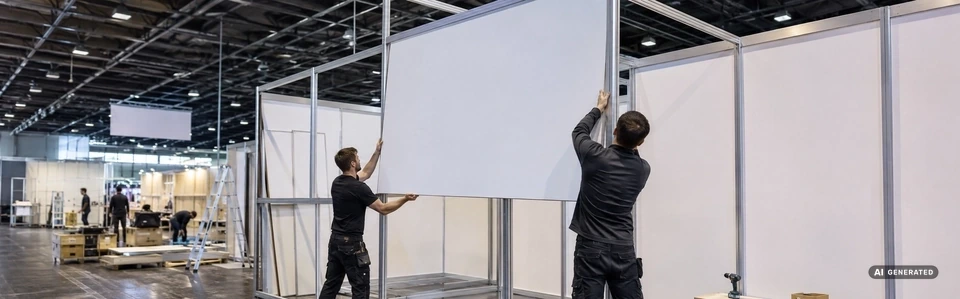
Aircell Panels for Trade Show Booths
The Aircell panel is not a standard extruded product, but rather a component manufactured using a patented 3D thermoforming process: Two thermoplastic outer layers are thermoformed over a geometrically defined air-cell structure and bonded together. The result is a monolithic panel without any adhesive or adhesive-bonded layers—maintenance-free, dimensionally stable, and capable of being processed multiple times. For an overview of all panel types, see the Aircell Panels product page.
Thickness / Basis Weight |
Weight per unit area |
Exhibition Stand Construction Application |
Material |
| 5 mm / 1,500 g/m² | 1.5 kg/m² | Display back panels, ceiling panels | PP |
| 9 mm / 2,300 g/m² | 2.3 kg/m² | Wall panels, room dividers | PP |
| 10 mm / 3,000 g/m² | 3.0 kg/m² | Counters, platforms, horizontal beams | PP |
| 14 mm / 4,000 g/m² | 4.0 kg/m² | Floor coverings, walkable surfaces | PP |
| 15 mm / 5,000 g/m² | 5.0 kg/m² | Structural components, load-bearing walls | PP |
Source: Panel Configurator at aircell-platten.com (as of Aug. 2026). Additional thicknesses and material options can be configured at: panel-configurator
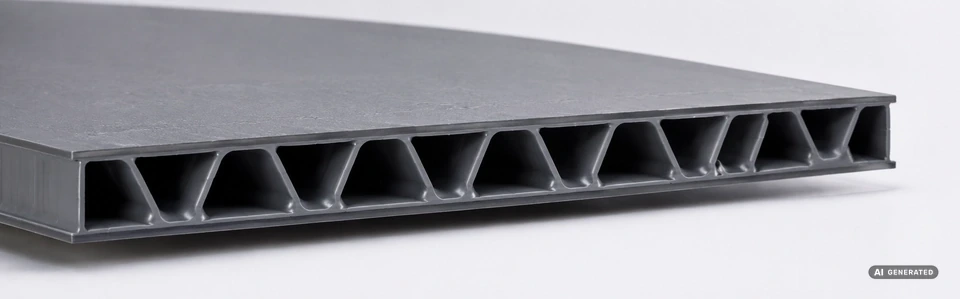
Upon request, panels can be manufactured with a non-woven coating (elegant finish), a TPE anti-slip coating (for floor applications), or in RAL colors according to corporate design guidelines. Configure your requirements directly in the panel configurator.
Lightweight, sturdy, and reusable
The ratio of surface mass to bending stiffness is the key selection criterion in trade show construction. A 10-mm-thick PP Aircell panel weighs 3.0 kg/m²—a comparable 10-mm-thick MDF cut-to-size panel weighs around 8.0 kg/m². For a typical 30-m² booth, this difference adds up to several hundred kilograms in total weight, which directly impacts transportation and handling costs.
Up to 70% lighter
Compared to solid-material alternatives (MDF, plywood) of the same panel size—a measurably lower transport weight.
Reusable several times
Thermoplastic face layers without an adhesive bond: The panels can be cleaned, reprinted, and reused seasonally.
Easy to edit
Sawing, routing, gluing, screwing—Aircell panels can be worked with standard tools, without the need for special tools.
100% recyclable
Pure PP, PS, ABS, or HDPE—fully recyclable at the end of their useful life.
For context: Generic PP multiwall sheets feature a rib-like internal structure that yields along a spatial axis when subjected to compressive or bending loads. The patented 3D deep-draw structure of the Aircell sheet distributes loads spatially—similar to a honeycomb core principle. Learn more about its lightweight construction properties on the product page.
Quick assembly and disassembly
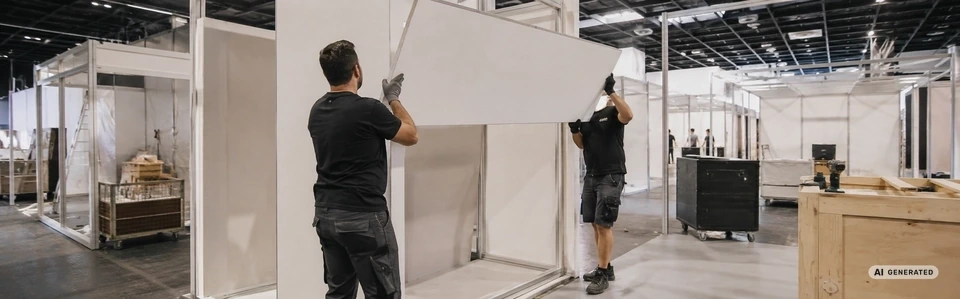
Exhibition stand builders calculate labor costs by the hour. Every minute a team spends handling heavy materials is paid time. Aircell panels can be lifted in pairs in standard exhibition stand sizes (1,000 × 2,000 mm to 1,250 × 2,500 mm)—slid into system profiles—without a crane, vacuum lifter, or any additional specialized equipment.
Overview of Installation Benefits
-
- •Panelscan be handled by hand—no lifting equipment required
- •Sawing, drilling, and gluing with standard tools right at the trade show
- •Stackablestorage: takes up minimal space in the warehouse between trade show events
- •Cleaningsurfaces with conventional cleaning products
Learn more about the use of Aircell panels in trade show construction on the corresponding overview page.
Sustainability in Trade Show Booth Construction
Exhibition stand construction is under increasing pressure to reduce its environmental footprint. Event organizers and clients are increasingly specifying ESG requirements in their requests for proposals. Aircell panels contribute to sustainability in three ways:
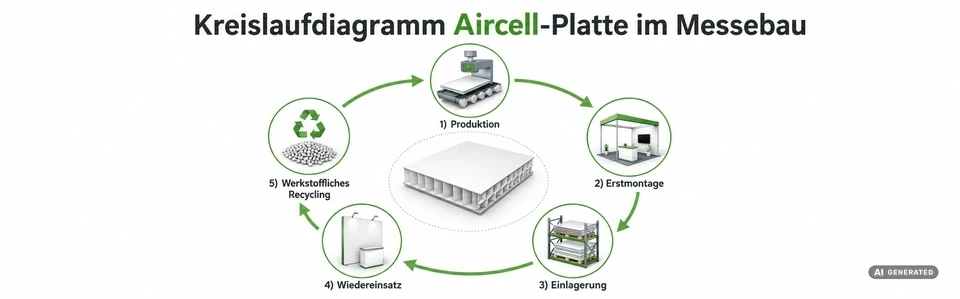
1. Reduce transportation emissions
Less weight means lower fuel consumption. For a 30-m² booth made entirely of Aircell panels, the shipping weight of the wall panels can be reduced by several hundred kilograms compared to an MDF solution. The actual savings depend on the shipping distance and vehicle load.
2. Reuse Instead of Disposal
Traditional MDF trade show display panels end up in the trash after one or two uses. Aircell panels are designed for repeated use—their surfaces can be cleaned, and prints can be reapplied. A longer service life directly reduces material consumption.
3. Material Recycling at the End of the Life Cycle
PP, PS, ABS, and HDPE are established recycled materials. After their final use, Aircell panels can be recycled by material type—without any adhesive or composite components. Learn more about the sustainability of Aircell panels.
References and Project Examples
Aircell panels are used in trade show construction on a project-by-project basis. Below are some examples of applications that illustrate the material’s capabilities. Specific reference projects can be provided by the sales team upon request.
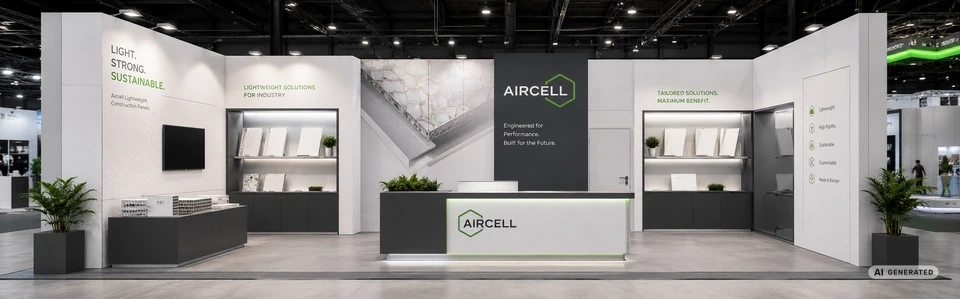
Typical Use Cases
-
- •Wall panelsfor modular booths (e.g., 9-mm PP, nonwoven-coated, RAL color according to CI)
- •Floor matsfor trade show platforms (e.g., 14-mm PP with a TPE anti-slip surface)
- •Ceiling panelsfor ceiling structures (e.g., 5-mm PP, painted)
- •Modularcounters and display stands (e.g., 10-mm PP, divided into sections)
- •Pop-up structuresfor roadshow use (e.g., 5 mm or 9 mm, reusable multiple times)
For specific format requirements or sample panels: use the Panel Configurator or contact us directly.
Frequently asked questions
How many times can Aircell trade show panels be reused?
That depends on handling, storage, and surface treatment. When used properly—protected storage, careful installation, and cleaning between uses—the product can last for several trade show seasons without any material loss. It is not possible to specify a definitive number of cycles across the board; upon request, the sales team can provide guidelines tailored to your specific application scenario.
What material is best suited for trade show wall panels?
PP (polypropylene) is the most popular choice in trade show construction: it offers good value for the price, is lightweight, printable, and recyclable. Your Aircell representative will recommend the right thickness for your project.
Are Aircell panels compatible with standard trade show construction systems (Octanorm, Aluvision)?
Aircell panels can be used in many standard trade show construction systems because they can be cut to the required dimensions using standard tools. Specific compatibility depends on the system provider and the depth of the profile groove. We recommend testing a sample cut beforehand or sending us the system specifications for an assessment.
Can I have Aircell measuring plates custom printed?
Yes. Printing options (logos, text, technical markings) can be specified directly in the panel configurator. Supported file formats for print data: PDF, SVG, AI, JPG, PNG. Non-woven-coated versions offer additional options for elegant surface finishes.
What are the minimum order quantities for trade show construction panels?
Aircell panels are configured as an industrial product in quantities based on the specific needs of each project. For information on minimum order quantities and batch-size calculations, please contact the sales team directly using the contact form or the panel configurator.