
The Aircell Container Ring System from VACU-form complements large load carriers (LLCs) with patented, deep-drawn PP container rings. Instead of solid plastic or metal rings, industrial companies in logistics, automotive supply, and e-commerce rely on Aircell’s ultra-lightweight, dimensionally stable 3D thermoformed structure. The container ring configurator offers five material thicknesses, seven folding types, and a flexible loading flap system—all tailored to your existing pallet and lid systems. The following overview is intended for buyers and logistics planners who use large load carriers in industrial-scale production and shows how the Container Ring System can be integrated into existing processes, what stabilization and closure options are available, and what you should keep in mind during configuration.
Advantages of the Container Ring System
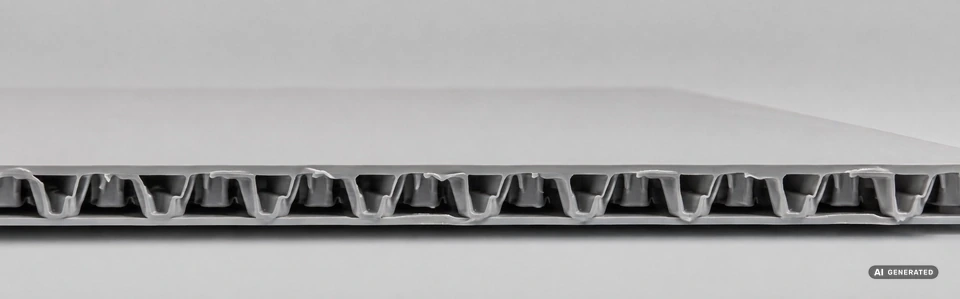
The key difference from generic hollow-core or solid plastic rings lies in Aircell’s patented 3D thermoforming process: Three precisely coordinated film webs create a three-dimensional structure that enables high resistance to pressure and impact while maintaining a very low weight. As a result, Aircell container rings are up to 70% lighter than comparable solutions made of wood, metal, or solid plastic and are 100% recyclable—two characteristics that have a direct impact on handling and the waste disposal footprint.
Added to this is the system’s modular flexibility: Five material thicknesses ranging from 5 to 16 mm and seven folding types can be freely combined, supplemented by customization options such as printing, stickers, document pockets, or locking openings. Since the rings are manufactured from the same deep-drawn air-chamber sheets as the Aircell sheets, they benefit from the latter’s resistance to weather and moisture, as well as their resistance to corrosion and decay.
In everyday logistics operations, the Container Ring System has proven its worth across a wide range of industries: as an attachment for pallet systems and roll containers used with large load carriers; in the automotive industry for just-in-time deliveries, spare parts logistics, and production supply; in e-commerce for seasonally scalable packaging solutions, and in manufacturing facilities for in-house material flow control in line with lean manufacturing principles.
Reducing Logistics Costs by Reducing Weight
Reduced weight is the most important cost driver in the Container Ring System: A lower tare weight per load carrier can—depending on route length, number of units, and type of freight—have a direct impact on transportation and handling costs. Less mass means less physical effort is required during manual handling and potentially more payload per trip, as the tare weight of the load carriers decreases.
Since Aircell container rings are 100% recyclable, switching to the reusable system also eliminates the need for ongoing disposal of single-use packaging made of wood or composite materials. The corrosion- and rot-resistant, weather-resistant design also reduces the need for replacements compared to materials that wear out more quickly when exposed to moisture or mechanical stress.
It is not possible to provide a reliable, blanket percentage estimate for cost reduction without knowing the specifics of your logistics chain—route structures, existing containers, and order sizes vary too widely from company to company. When you submit a customized inquiry via the configurator, the Aircell team will use your key data to determine what savings are realistically achievable in your specific application.
Stabilization for Safe Transport
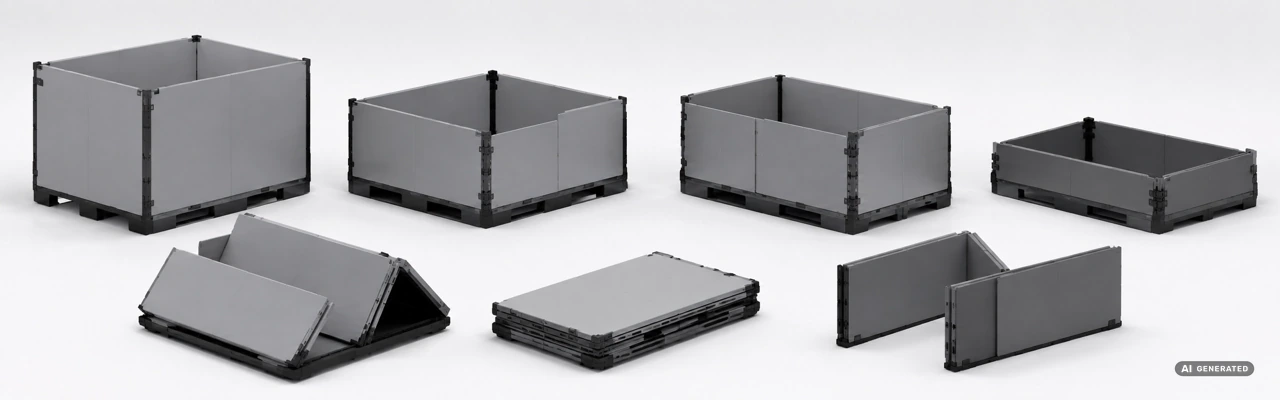
The stability of the Container Ring System is based on two key factors: the selected folding type and the closure system. The configurator offers seven folding types via image selection—ranging from a continuous ring without a separation to C-ring variants on the long or short sides, symmetrical with pressed, overlapping edges, to designs with a removable front wall or a folded-in C-ring with a straight front wall. Each type is designed for different loading situations and existing logistics processes, ensuring that the ring fits seamlessly into your material flow.
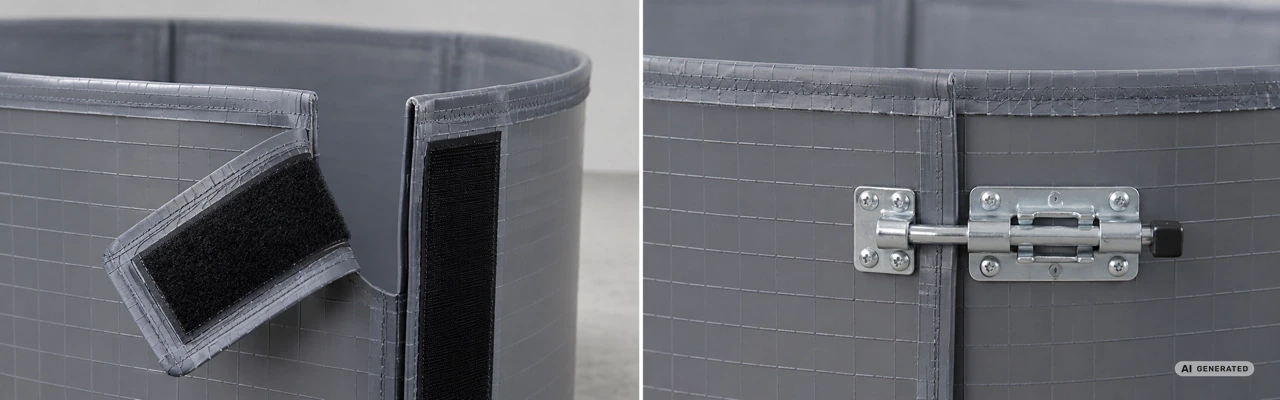
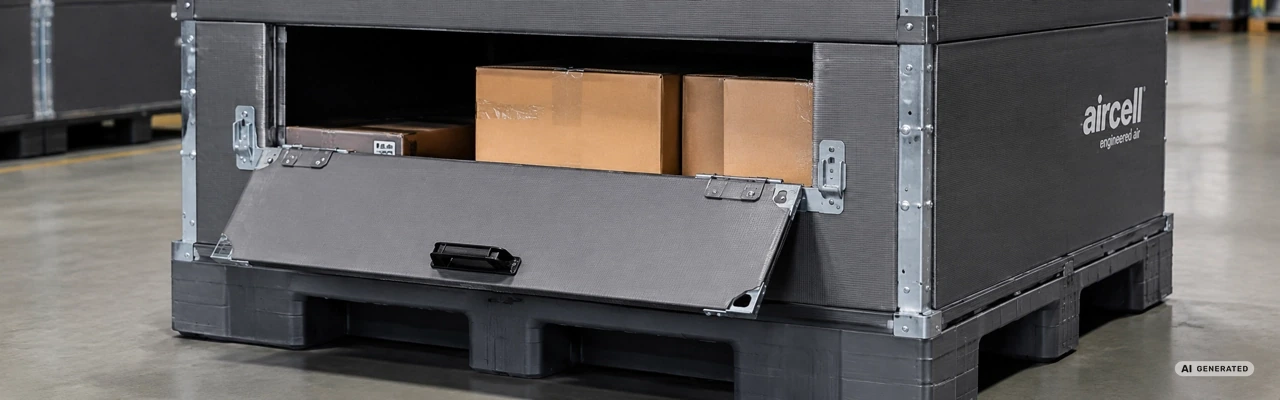
For the loading hatches, there are two proven closure options to choose from: Velcro with a loop side for quick, reusable handling during frequent opening, or a sliding latch for maximum security and stability with heavy loads and a correspondingly high-quality appearance. Both closure options utilize the same patented 3D deep-draw structure that already gives Aircell panels their high resistance to pressure and impact—meaning container stabilization is not an afterthought but is directly integrated into the material design.
When selecting the right type of folding crate, access to the cargo is just as important as the direction of the load: Models with a removable front panel allow for quick side access, while continuous rings without a partition provide the highest level of all-around stability with even load distribution. You can use the configurator to determine which folding type is best suited for your cargo and picking operations by comparing images directly.
Configure Custom Sizes
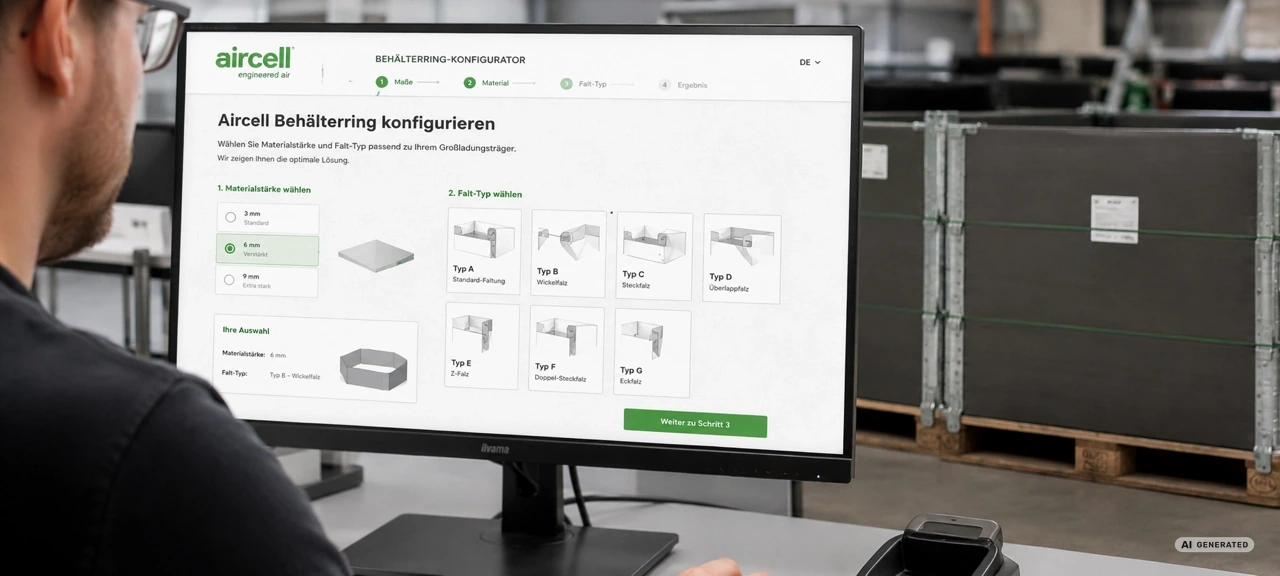
The configuration begins with the basic dimensions—length, width, and height—of your container ring, which are customized to fit your specific transport containers. In the second step, you select one of five material thicknesses using the Aircell container ring configurator; the system automatically filters the corresponding basis weights to ensure that no incompatible combinations can occur:
Material thickness |
Recommendation Based on the Configurator |
| 5 mm | Lightest-duty transport applications |
| 9 mm | Light-duty transport applications |
| 10 mm | Standard Logistics Solutions |
| 14 mm | Reinforced version |
| 15 mm | High load capacity |
| 16 mm | Maximum Durability |
Source: Aircell Panel Configurator, aircell-platten.com (as of June 2026)
Next, specify the folding type, number, and position of the loading hatches, as well as the locking system. The configurator dynamically adapts to your inputs: The positioning logic for the loading hatches automatically responds to their number, and incompatible options are hidden. Technical drawings, logo files, and print templates can be uploaded directly via the form (formats: PDF, SVG, AI, JPG, PNG; max. 50 MB per file). All information is automatically incorporated into your customized quote—including the pallet and lid systems you use—to ensure the dimensions fit exactly.
The process is guided by tab-based, step-by-step navigation through the sections “Basic Information,” “Folding Types,” “Configuration,” and “Contact Information”—all available in both German and English. Once submitted, your request is automatically forwarded to the Aircell team of experts, who will prepare a customized quote for you.
Installation and Use
In day-to-day operations, ergonomics are key when loading and unloading. The Container Ring System allows for between zero and four loading hatches, which you can position as desired—tailored to the direction of access and stacking order in your warehouse. Various mounting options are available: handles for manual transport, H-profiles, and compartments for organizing the interior, as well as other custom fittings depending on the cargo.
Additional features can be enabled individually depending on the application: Printing for company logos, product labeling, or barcodes; interchangeable label systems; weather-resistant document pockets for delivery slips; and lockable openings for additional theft protection. Printing and stickers can be specified separately for each side—short sides on the left and right, long sides on the front and back—so that the placement matches your container and labeling requirements exactly.
The entire Container Ring System is manufactured at the Salzbergen facility in accordance with “Made in Germany” standards; its modular design facilitates future maintenance and repair of individual rings without having to replace the entire load carrier.
ROI Estimate for Your Company
A thorough ROI analysis of the Container Ring System takes several factors into account: the weight per ring and its impact on transportation and handling costs; reusability in a reusable system versus single-use solutions; recyclability at the end of its service life; and damage prevention through a custom-fit, stable design rather than standard sizes that do not fit the cargo exactly.
The extent to which these factors affect costs and payback time in your specific case depends on the number of units, route length, and the existing container system—it is not possible to provide reliable estimates using fixed metrics or flat percentages without this company-specific information. Submit your request via the configurator: The Aircell team will review your key data and typically provide a customized quote within 24 hours, including an estimate of the potential savings for your logistics operations.
Parameters |
Specifications |
| Material Thicknesses | 5 / 9 / 10 / 14 / 15 / 16 mm |
| Folding Types | 7 variants (including one-piece wrap-around, C-ring on long or short side, and with removable front panel) |
| Loading hatches | 0–4, freely positionable |
| Closure Systems | Velcro with loop side / Sliding latch |
| Features | Printed text, stickers, document pocket, locking opening |
| Materials | PP |
| Weight | Up to 70% lighter than comparable solutions |
| Recyclability | 100% recyclable |
| Manufacturing | Made in Germany (Salzbergen) |
| Offer Period | usually within 24 hours |
| File Formats (Templates) | PDF, SVG, AI, JPG, PNG (max. 50 MB per file) |
Source: Aircell Container Ring Configurator (live; the configuration status takes precedence over PDF values) and Aircell Roll-Up materials.
Frequently asked questions
▸ What material thicknesses are available for the Aircell Container Ring System?
The Aircell Container Ring Configurator offers five material thicknesses: 5 mm, 9 mm, 10 mm, 14 mm, 15 mm, and 16 mm. The system automatically filters the appropriate basis weights for each selected thickness.
▸ How many folding styles can I choose for my Container Ring?
You can choose from seven folding types using the image selection—ranging from a continuous ring without a separation to C-ring variants with crimped, overlapping edges, and designs with a removable front panel.
▸ How many loading hatches are possible on an Aircell Container Ring?
Between zero and four loading doors, freely positionable for ergonomic loading and unloading of your large-capacity load carriers.
▸ What latch systems does Aircell offer for cargo doors?
You can choose between Velcro with a loop side for quick, frequent opening and a sliding latch for maximum security when handling heavy loads.
▸ How does the reduced weight of the Aircell container rings affect logistics?
Aircell container rings are up to 70% lighter than comparable solutions and 100% recyclable. This has a direct impact on handling costs and disposal expenses. The specific savings possible in your case depend on the quantity and application and will be calculated in a customized quote.
▸ How soon will I receive a quote after completing the setup?
Typically within 24 hours of receiving your request via the Aircell Container Ring Configurator.
▸ Are Aircell container rings compatible with my existing pallet and lid system?
In the configurator, specify which pallet and lid system you are currently using. The dimensions of the container ring will then be customized accordingly.